Home Brew - Before the Leaves Fall


Home Brew changes to “Before the Leaves Fall”

I like Colonel Wilbur Gray's adaptations of Fire and Fury. However, his adaptation for WW1 doesn't distinguish the period as much as I would like from the Franco Prussian War. I have been reading some of the very good books on tactical level actions on the early stages of WW1 and I have come up with a number of further refinements that i think make the basic rules more representative of the early part of WW1

Figure scale

The proposed figure scale is 360 men per element. For a four Battalion British Brigade at 1000 men per battalion the current rules give this a strength of 12 elements per Brigade. However, at this ratio (4000 ÷ 12 = 333) per Brigade. The same applies to a German Regiment with 1080 men per battalion and 99 men in the MG Company (3339 ÷ 10 = 333). I have therefore decided to round this scale to 330 men per element.

Figure Basing

My 15mm figures are based on 2 figures on 25mm frontage. A fundamental assumption and decision is that I don’t really want to rebase all my figures. I would rather use them to fight battles with!

Ground Scale

Given my element basing I have opted for a reduced ground scale by making 20mm the new inch. I use a pace stick marked of in “inches” (at 20mm per inch) to measure movement and weapon ranges. For a 48in (120cm) square table this approximates to 10km grid square. Ample size for most WW1 battles.

Recalculating Figure Scale

Using this ground scale means that each of my elements is 1.25 wider than BTLF elements than they should be at this ground scale. Hence the figure scale increases to 400 men per element at my figure basing scale and ground scale, and comparable increases for cavalry and Light Infantry to 200 men per element.

With Artillery, given the cost of models and time in painting and being a cheapskate, I have changed the artillery scale to 9 guns per model, or 2 models per artillery battalion (or equivalent irrespective of nationality).

The consequences of this on the fire chart are that, keeping a baseline of the infantry firing as the norm, this means that:

  • The MG company firepower is downrated by 0.825 (330 ÷ 400 = 0.825)
  • The artillery firepower is uprated by 1.2375 ((330 ÷ 400) × (9 ÷ 6) = 1.2375)

The alternative to changing the artillery to 9 guns per model is to keep it as the current scale, but then reduce the firepower by 0.825, the same rationale as applied to the MG company.

Line Formations

When not in March column or field column there are no restrictions on how many elements should be in the first line or second line of a line formation. However, to count as being supported in charge combat there must be approximately equal elements in the first and second line (plus or minus one element) and these second line elements must be within 1in of the front line they are supporting.

Previous restrictions and movement penalties on moving obliquely, or to the flank etc no longer apply as infantry companies and cavalry squadrons are considered to move independently once deployed in line formations. These restrictions and penalties still apply for all column formations

Introduced a new formation - Open Order

A careful examination of reports and maps from WW1, it seems that brigades covered a greater frontage than the normal line formation caters for under the rules. In fact, a brigade/regiment should almost take up double the width of its line frontage in elements.

I have therefore introduced Open Order as a valid formation of line infantry and dismounted cavalry:

  • Open Order is where the elements are up to one element apart from the adjacent element to front/rear or to the side. To be classed as being in open order at least half the elements must be separated by more than half the width of an element.
  • To move whilst within Open Order each element moves independently its maximum permitted movement distance for that March Phase.
  •  A unit in open order that gets a “STALLED” result in the March Phase can still advance depth elements up to the front line of the formation, but no closer than that to the enemy
  •  A unit not in open order that has a “CAUTIOUS” result in the March Phase may move out into open order.
  • Units may enter open order by moving each element independently as described.
  • To reform, an element is nominated as the guide and each element moves independently to the new formation. It takes at minimum of a move to reform, in some cases it may take 2 moves to reform, until the unit reforms fully in a column or line it is classed as being in open order.
  • Each element in open order has a firing arc of 45 degrees.
  • If in more than one rank, the rear rank can fire through the gaps in the front-line elements at targets within its arc of fire.
  • There is a -1 factor for the March table. Given the wider dispersion it is more challenging to pass new orders to all the companies or squadrons in the Brigade.
  • There is a -1 factor on the firing table for targets in open order
  • There is a -1 factor for any unit charging in open order
  • There is no negative factor to defend in open order because at point of contact the open order formation is likely to be outnumbered; especially if the attacker is in a standard formation.
  • Units in open order cannot benefit from the Shock Infantry bonus in melee

Overhead Fire

In this period the artillery is much more capable of firing over own troops. If there are intervening friends who are not dug-in or within hard cover of the within 4” of the firer or target the artillery may not fire.

The normal overhead rules apply to German MG batteries

Indirect Fire

This is redefined as being solely off-table fire from supporting howitzer batteries or heavier corps support artillery.

  • There must be an observer on the table who can direct any supporting artillery fire he has been allocated. Each observer can control up to 4 batterys.
  • The observer is moved and deployed by a commander, in a similar manner to the way that a commander moves an artillery battery
  • The observer can carry out two of four possible tasks a game-turn: emplace (Set up the equipment and comms), observe, displace (pack-up all the equipment), move.
  • If a friend unit within 2” of the observer receives fire and a dice roll of 10 then the observer may be a casualty; resolved using the fallen Generals table. If he is a casualty then the off-table indirect fire missions under his control cease for the game.
  • Each battery in support off-table has the following fire points at any range up to 30in from the observer:
    • Light field howitzers less than or equal to 105mm - 4
    • Medium Howitzers and guns Greater than 1055mm and less than or equal to 155m – 6
    • Heavy howitzers or guns greater than 155mm – 8

Artillery Movement Modes

Medium or heavy artillery can only perform one artillery action per turn, and they cannot prolong.

Defilade Fire

This is only possible for on-board howitzers and mortars. It assumes that there is an integral observer, deployed away from the battery observing and directing fire.

  • The artillery element can be placed up to 2” behind intervening terrain or a crest of a hill.
  • The minimum range for the artillery is 12”
  • The indirect fire tables are used to calculate fire points.

The notional observer is vulnerable to fire. If any unit within 2” of the artillery elements comes under fire, then with a dice roll of 10 the observer may be a casualty; this is resolved using the fallen Generals table. If he is a casualty then the artillery cannot fire until the observer is replaced (Replaced in the replacing fallen generals’ phase).

Alternatively, the battery can deploy an observer element as with indirect fire described above, that can move independently from its battery on table. This observer can only control the battery he belongs to.

Counter Battery Fire

Even if a battery is in defilade it may be subject to counter-battery fire as the enemy may spot gun flashes. If an artillery battery or observer has a line of sight to the terrain that is protecting the defilade battery it can engage in counter battery fire. This fire has a modifier of a ½

Digging In

Infantry and cavalry dismounts can attempt to dig in during the March Phase. The maximum cover that can be obtained by digging in during a game turn is 1 point of cover. To successfully dig in and achieve this the following conditions must be met:

  • The unit must first pass a test on the March Table that with a result that is better than or equal to “Stalled” to start digging. If digging in, in any form of cover, then subtract 1 from the dice score when the unit rolls on the March Table.
  • Digging ceases for the game turn in which the unit moves or fires, is fired upon and is disordered from the result, or receives a charge. Unit’s ceasing digging unit can try again in a following turn by re-rolling during the March Phase.
  • If a unit digging does not, fire, move, is fired upon and disordered, or charged it occupies its field defences at the start of its March Phase if it rolls a result better than or equal to “Stalled”. If digging in, in any form of cover, then subtract 1 from the dice score when the unit rolls on the March Table.


AOE(BTLF) - Game 1 Report

 WW1 Wargame - A test of "Before the Leaves Fall"

I have been trying to find a relevant set of wargame rules for the early part of WW1 for about 22 years! I wanted to play at the Divisional and Corps level using 15mm figures as I rather like the Peter Pig range. As an aside I might have gone for 10mm if they had been available when I started.

I am a fan of Brigade level ACW Fire and Fury (using 10mm). I also like the variants that Colonel (Retd) Wilbur Gray has produced for 7YW, Napoleonic’s, 1870 through to now WW1. They seem to support the level I like to play at. Rather than worry about the nuances of a battalion or cavalry regiment one commands brigades or regiments. I am more comfortable dealing with the Brigade and regimental level where the battalion level detail is somewhat abstracted.

Consequently I have been playing around with the variant for WW1 – Before the Leaves fall (BTLF). I was not initially in favour as I didn't think the rules were sufficiently different from 1870. I have, however, introduced a number of refinements that I think help give a better flavour of WW1. These include an open order formation for infantry and dismounted cavalry. The ability to dig-in during the game – shell scrape level, not full stage 2 entrenchments with overhead cover! Changing the figure scale to suit my basing. Some off-board refinements for indirect fire support from Corps level assets.

All of this is wrapped up in my computer moderated solution that provides some measure of solo play ability by making command decisions for the commanders.

I had a test game and I thought I would share my findings and the photos. 

The overall game seemed to play out in a Mons-like way. The Brits defended the river line with three brigades up and a cavalry Brigade in reserve, with artillery distributed along the front. The German Corps committed a brigade of 2 regiments against each bridge with most artillery support concentrated on the centre bridge. The game lasted 13 game turns from 1000 to 1530, and was a narrow tactical victory for the Brits who only vacated their defences towards the 12th turn around 1500.

It might have been very different. The German Brigade on the left had real problems. It managed to advance to the first hill in open order, and there it stayed or retired from it for the next 9 turns! Rolling usually a 1 or 2 on the March Table every turn! By the time it started to move it charged across the bridge in open border, overran an artillery battery in the village and then proceeded to abandon all of its gains and retire twice northwards away from the bridge. Meanwhile the Brigade’s reserve regiment came on and then dillied and dallied around on the hill on the German side of the river exactly as the lead Brigade had done!

Looking from the German left flank. The Regiment in open order are the ones who were dillying and dallying around!

Overall, the game, less scenery which I did in haste, was a reasonable success and I am now more confident that the rules with the refinements might well be a working solution for the period.

The map is autogenerated randomly for me by a little application I wrote in Powerpoint.

Playing in the Sand

Revisiting games of yore - Approximately Maiden Castle

44 years ago while serving in Germany I ran the regimental wargame club. We used to play mostly ancients and cold war modern (no surprise there I suppose!). 

One day we noticed that there was some building work going on, with a pile of sand waiting to be mixed into cement. This got the collective brains of the club thinking, could we make a sand table to fight games on? Well thought leads to action; sand was liberated and the board was created.

We used it for a number of modern games, but the culmination of the use of the sand table was to build an Iron Age Hill Fort. 

For the game we used WRG 5th edition rules, and collectively pooled our barbarians to defend against the might of the Roman Army. The following are the original pictures we took and which I recently scanned in to share with you all. The quality isn't the best but it gives you a good feel for the game we had.


The Romans battering ram has reached the gate, along with two cohorts supporting the attack each side of the gate. To the right the Assyrian archer cohort is providing supporting fire.

The cohort to the right of the gate has set fire to the palisade and in doing so forced the defenders back.

The battering ram has penetrated the gate, while the cohort attacking through the burnt palisade has now breached it and seized the rampart. Meanwhile another section of the palisade has been set alight, and in the foreground on the Roman right flank the Barbarian light troops are defending against two auxilia cohorts.

The reverse angle

As the lead cohort behind the battering room enters the hill fort, the Barbarians have manned their second line of defences. In the foreground the far left flank Auxilia cohort has driven the defenders away from the palisade. 

The right hand Auxilia cohorts have now breached the palisade and started to push the defenders back.

The Barbarians light troops on the left have rallied and thrown the Auxila cohorts back over the palisade. The Assyrian archers have moved up in support of the Auxilia. However, in the centre all is not going well for the Barbarians. The Roman General has released the Moorish Light Cavalry into the hill fort to destroy the defenders streaming back from the outer rampart.


The Barbarians' heart and will has broken (with some pretty poor morale dice). The Moors have penetrated to the heart of the Hill Fort. Meanwhile a Roman cohort has breached the inner defences as well. Elsewhere the Romans are pursuing the routing defenders around the defences. A crushing victory for the might of the Roman Army.

Automating Fire and Fury

 Automating Fire and Fury

This wargaming project came about when I wanted to play Fire and Fury better solo, and to try and help speed the game system up a little. Also I wanted to see what difference and benefit modern tablet and touchscreen computers might give to computer moderated wargames.

The latter motivation came from the poor user experience using keyboard entry for games. It had occurred to me that when one is playing one is always using ones finger on the quick reference sheet (QRS) to find one's place and to help generate an outcome; particularly as one runs one finger down the column on the QRS to check off , for example, morale options. Therefore I mused why not use one's finger on the computer screen to get an even better result!

So far I have automated to some extent or other:
  • Fire and Fury, and Col Wilbur Gray's derivatives for Seven Years War through to Early WW1
  • Principles of War
  • Bloody Picnic
  • Battlegroup Kursk
  • Bolt Action
  • Corps Commander - Bruce Rea Taylor's 1980's Modern Rules 
  • Combat HQ
  • Cold War Commander
  • Wargames Research Group WW2 
The one big thing I discovered is that using the rules as a computer specification to design a solution around, really helps you understand the rules and whether they are internally coherent or not!!

Computer Specification

The programs are written in VB.net and designed to run on a Window machine. You don't need the internet while the game is running. You don't need a touch scree, but it is certainly a lot, lot easier to do so!

The Basic Fire and Fury Solution

The following are pages from the "Program manual" I created for it. The screen images are from the program. I added into the game sequence a "Game Event" step to cater for reinforcements and other events that might impact the commanders.


Next Step Improve it for Solo Play

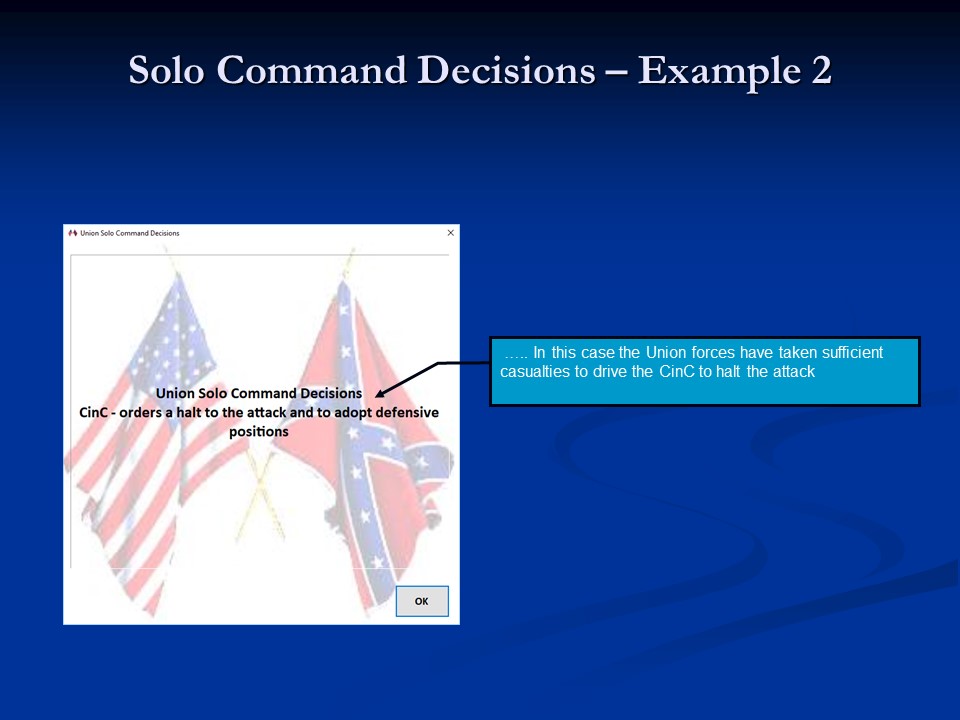
Once I had proved the solution for the basic game I then extended it to help me play solo. The key to this next step was to determine possible key actions that commander might take based on their ability and character. I will discuss this in a future post, but the followings screens will give you an idea of what is involved and how it impacts the game.


Sharpe Practice - Game Report 2

A further encounter in 1809 Kevin and I decided that we needed a break from ADLG and CoC so a mutual decision to enter the world of Sharpe ...